Showing posts with label supernova2008. Show all posts

Tuesday, June 17

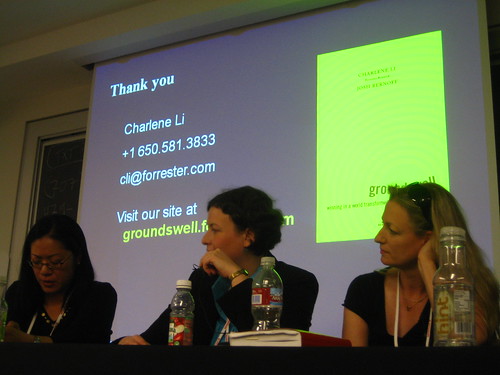
Supernova 2008 Day 2 - Panel: "People: What We Know and What It Means"

Originally published on ConversationHub

Speakers: BJ Fogg (moderator), Charlene Li, Eszter Hargitti and Elizabeth Churchill


BJ Fogg from the Persuasive Computing lab - how do you motivate and persuade people.

Studying people: can study what is in people's brain, also look at how people perceive others, diads (how people interact), small and large groups, clusters of groups and cultures/world.

Elizabeth Churhill - Yahoo Research - ethno-centric fieldwork

Presentation: People - what we know and what it means....to us and to them

People are endlessly creative - few tools are good at complex knowledge sharing

Very few tools are good at helping teach people (instructables) - teaching how th groups share knowledge to each other - video, text, cell phones, etc - to share procedural motor skills. [Take a look at Make from Bre Prentis]

SuperNova 2008 Day 1 - Spotlight on Social Computing

Originally published on ConversationHub

Presentation from Joe Kraus from excite, JotSpot and now google

Social is the new black? Nah.

We have always have been interested in others. All of the social apps are about connecting - social networking is the latest, most efficient way - but it is not new.

Three new paradigm shifts:
  1. Information discovery is changing - changing from a solitary activity to a social one.
    • How we share information moving from active to passive. Less interruptive.
    • Asynchronous relationship to sharing about personal activities: people are often extremely interested in what people are doing, but assume that most others are not very interested their lives.
    • For example: sending photos via email - requires a high social activation energy from the sender. Usually - this requires the person sending to feel that they are "important".
  2. Separating access to content from notification of content existence
    • Clay Shirky’s "publish, then filter"
    • Result: we are sharing a whole lot more. Seeing the rapid uptake on Facebook Newsfeed and FriendFeed.
  3. Moving from focusing on social sites and onto the social web
    • Right now, we go to Facebook and MySpace to "be social".
    • It is always about something we "did" at a site.
    • Web 1.0 examples: epinions, tripadvisor.
    • Today, increasingly social sites are the hubs of social activity. But the web itself should become more "social" - to know connections between people and need.

Thoughts on Google Friend Connect:

Currently, my identity on the web is very fragmented. How do I bring it together and federate it? How do I give secure access to a site to get personal account info?Emerging standards:
  • Identity: OpenID
  • Authorization: OAuth
  • Apps: OpenSocial

Google Friend Connect - trying to bring the three standards together.

OpenSocial allows for embedding social apps onto the blog. Allowing for connectivity - middleware for connecting between apps and data on different sites.

Next up, Presentation from Ozzie Diaz (Wireless/Mobility CTO, HP)

Title: From Mobile Computing to "Always Connected"

Marketplace always starts with: "Mobility and HP???"

Unfortunately, it is not that apparent - HP builds a lot of devices. HP is moving to the "always connected" user experience.

Richness versus Reach - many form factors, UIs and screens - from a user perspective - what is the relationship between/among all my devices. There is a fundamental issue with training behavior with new behaviors.

The Crossover - moving from CPU/device based to Cloud-based user experience:

[Ed Notes: OMG! we are back to the fat client/thin server versus thin client/fat server - I see "Chaos" on the screen].

Ozzie asks for a show of hands on how many connected devices we have. Lots of people with many connected devices. Device complexity and proliferation: grows with an order of magnitude.

The Complexity of Networks: insane number of technologies and devices - permutations insane.

Blurring the lines between our digital and real lives: Work (colleagues) - Home (household) - Community (friends) Connected experiences...always: devices to content.

Connections between people and content are the experiences not the technologies.

General Q/A:

Kwerb: how do social and mobility connect?
JKraus: more than likely the strongest connection is the list of frequently called friends.
Keep up with your friends actions/activities on your device.
Ozzie: seeing in emerging markets (AsiaPac), need for social interaction is no lesser, they are moving to "mobile experiences". Millions to 100s of millions - the two will have to coexist.

Kwerb: Carrier and operators in the middle - think that social computing model will translate into the mobile world?
JKraus: I steer clear of cable discussions.
Ozzie: Lately, sees more "positive" behavior to more open models. Interesting to see how to handle when your business is being eaten away by companies that play the open model. There is always a tension on the CAPEX spend on networks and the drive to make a network just be the "stupid network" - you just get by, we will do the services.

John Patrick: Discussion on moving to the social web - no marketing behind the idea. All of the products mentioned, there are unrememberable URLs, no info for non-techs, no value-proposition that is clearly articulated. When will someone spend the marketing dollars to get clarity?
JKraus: A consumer should never have to know about OpenID - the experience should be seamless and focused on easy login.

Marc Pinkus, Orange Labs: Genie - anyone remember? Multiple devices, multiple networks. How will you handle connectivity across multiple networks - authentication with light-weight devices.

Esther: Heading toward a singularity - going to connect to all of the networks, all of your friends, etc. Should you be revealing your social graph? What happens when we reach the "end state"? And then what happens after that?
JKraus: google lives-or-dies on privacy. My POV - first starts with more granular privacy that previously enabled. I am a "first problem we need to solve" kind of guy. Right now, the challenge is that, for example, giving my gmail account info gives the third party site the ability to access ALL of my information. I know the first step is to offer granularity to the user in terms of what people can access (e.g. address book).

Supernova 2008 Day 1 - Exploring the Opportunities

Originally published on ConversationHub

Jonathan Schwartz - Case Study: Restructuring IT

Five years ago: Sun thought: "people want the cheapest storage devices, but highest storage reliability - with products that are not reliable."

From this effort, out popped ZFS.

In 2005, Sun decided to give it away for free - something that had taken 100s of millions of dollars in development and Sun decided to give the architecture AND the source code away for FREE.

After a year, ZFS has been ported into MacOS X (Sun Leopard), ports were done to Linux community - and has gone around the world - essentially teaching people how to use storage, not manage it.

Around 2006-2007, Sun now launched a piece of data storage tech - "Thumper" which had 24T of storage at a cost of about $1/Gb. In two quarters, they went from 0 to $100M in revenues - simply because the community was already prepped for the product offered by the introduction of ZFS to the community.

So, there are two reasons to invent the product:
  • Attract the customers - if the marginal cost of adding a user is zero, then you want to add as much customers as much as possible.

He then shows the following map: http://www.sysnet/sunwarp.net/maps

Map of ZFS Registrations

Downloaders of the ZFS source code have to "earn" registration - if a company mandates registration, many people will often not do it. But by earning access and agreeing to share the information, the customer gets something (access). in exchange for this registration, Sun gets a "dot".

He then shows a photo of 13M dots who have downloaded the ZFS system.

"Internet makes it easier to attract the customers across the world. Dots tend to cluster around population and academic centers. The dot tells how/where a customer is. After our acquisition of mySQL, we are adding approximately 100K new "dots" a day."

Q/A:
Kwerb: terrific - sounds great - questionable on building a sustainable business. Like, isn't this simply another Java-like model?
JSchwartz: licencees of Java on small devices are already making a nine-figure revenue stream. With mySQL, there is already a $100M revenue stream upon purchasing - and we own the intellectual property. With ZFS, very different.

Kwerb: So, it is about distribution?
JSchwartz: Since it is appealing to the developers (being open source) - we learned that the ratio is 1:1000 for developers to users. And, as you drill down further, a small subset of users will become the paying customers. Thus, the commercial clients make money around mission critical support. As I said, with mySQL - prior to purchase, already had a $100M situation. With ZFS, we had a better chance to monetize.

Kwerb: How do you monetize?
JSchwartz: It is about our class of customer - users who have more time than money: they are the user of free software. In the situation of Facebook - they have much more money than time - thus, they are now a paying licensee. Gotta remember that if the product is not free, the customer will pick someone else. If free, you are in the conversation.

And, just because you are not charging for your product, you can not simply ignore the customer. Just like a media company, you make money from your customers (the advertisers/the corporates), as long as your content is interesting to your customers/viewers. So, by giving away the source code for free, we have been able to grow the customer base. Free and popular tend to go hand-in-hand, but not necessarily.

Kwerb: how do you distinguish?
JSchwartz: Retells a sory about a meeting with a large group of corporate CIOs and asked about how many companies had downloaded mySQL. Almost all of the CIOs said "no, not our company". But JSchwartz checked his logs and found that every company had at least 100 downloads to their IPs.

Anyone who can use adoption to drive revenue will succeed in this model.

Kwerb: So, how do you change the direction of the supertanker (Sun)?
JSchwartz: lesson learned: can not change immediately. It takes time - need to work on it slowly and methodically, and then suddenly the acceleration occurs.

Shannon Clark: So, you collected all of that information? How did you know what to collect?
JSchwartz: simply, collect everything - you never know when the data will be valuable. But make sure to be transparent - being a little sneaky can have terrible consequences (see Beacon on Facebook).

Kwerb: Open source doesn’t it conflict with IP?
JSchwartz: We have 14K patents - and we do not sue or are in a legal mood. We have made sure that we own the IP of anything that is woven into the Sun products/OS code. In all of the OS communities - Sun owns all of the IP - and can change the terms at any time.

Some of the commercial companies need a commercial license - so Sun retains the flexibility and are able to control their own intellectual property.

Kwerb: Sort of a kind of ju-jit-zsu?
JSchwartz: Simply, you need to control your own intellectual property to be able to have control of your destiny.

Kwerb: Thoughts on Microhoo?
JSchwartz: Well, if the marginal cost of acquisition of a customer in this space is going to zero, and your business is based on getting people to pay for licenses is threatened. It was incredibly difficult for Sun - but changed the company’s situation with customers.

For example, OpenOffice was launched 10 years ago. Today, there are over 110M unique users for OpenOffice. Companies that are offering $200-300 per license will find the next generation of purchasers a challenge.

I think we are in the second inning on the Internet services - the first was search, the next was news, and now infrastructure software. But there are plenty of things have not been impacted by network effect yet - but they will.

For example: cars - not yet. Carriers have been - they offer the free phones to get you on a plan, banks offer free checks. Major consumer-based products have not been able to do this.

Imagine what would happen if a phone was given that would have a completely free calling plan. While, the consumer benefit is not readily apparent - companies will use analytics to make good money out of the data.

Wednesday, June 20

Supernova 2007 - Changing Politics

Question from JD: what is your personal interest in politics and culture?

Victor: Is the Internet capable of rewiring politics? Possibily of bringing in people who have tuned out politics. may be able to bring in some very temporarily. Will we have the same as
Does not think it will rewire politics - no evidence from the blogosphere, electronic town halls, podcasts - nothing is changing the landscape. What does technology do to politics at all? Information flows can be rechanneled and optimized to existing stakeholders - a slight improvement on decision making.

Andrew: got into politics when he was running a night club in NY - concerned with Guliani - joined the community board where the club was - got very active in the local community. 3000 students, 97% on schol lunch, not a computer anywhere. Asked 10 friends - 200 people helped wire the school - became MOUSE for technical support for schools. Public education funding was through politics - discussing technology and education. Politicians do not know the difference between a server and a waiter. Began to give advice to various Democrats - Gephardt, Clinton, - only followup was fundraising requests for $$$.

Became the chairman of the Howard Dean Technology Committee - helped raised money and visibility - raising money generated visibility. In 2003, started Personal Democracy Forum - and grew the magazine and the conferences. Two schools of thought:
  1. Technology can be used to maintain top-down control - direct-mail for the 21st Century. Example: MoveOn.org - small group of people who determine the agenda and hope others follow.
  2. Technology creates an opportunity for a more robust and participatory Democracy - believe that top-down will be disintermediated. Belief that citizens will connect politics to their lives and reconnect, whereas television has disconnected. Example: Sunlight Foundation - exposing government data to citizenry
Took 15 years before television truly impacted politics - we are in the very early stages of how Internet will impact.

Julius: be descriptive on one element going on now - Julius has been in the private sector - believe that Internet will change politics. Same belief that Internet would have a lag time. We saw the beginnings of it in Dean, thinking that it would be historically significant. Friend of his decided to run for President (Obama) and interesting to see how the campaign is wrestling with the technology and its impact.

What's going on at Obama08.com - tools are familiar from a commercial perspective
  1. Over 600K have signed up for BarackObama.com fo a website that has been up since Feb 10th - 4 1/2 months
  2. Series of social networking features on the site
  3. 70K people have created a profile without any advertising at all
  4. Set up groups and meetings - traditional organizing tools - 5000 groups have been set up on BO.com, 10K meetings have been organized where over 50K people have participated
  5. Basic blogging function - 13K people been blogging on the community site
  6. Early stages on using technology on the policy side: simplified wiki solution for healthcare
100K contributors, 50K were online - of the 50K, 50% were $25 or less, 90% were $100 or less
Mobile - "go" to OBAMA on the networks - just launched

All of this stuff is in beta - all of this is being experimented with - early strong indication for this to participate.

JD Lasica: The Remix Politics Channel - ourmedia.org - give people resource materials/tools/original footage of past Presidential Campaigns and can remix and mashup and create a commentary thoroughout the election.

Question: Andrew Stern on Bill Moyers - how the Internet is changing politics - is MoveOn.org in a position to influence politics? Is this a good thing for the Republic? Is this making compromise more difficult? Disrupting politics as usual? Is it impacting public policy in a good way or a bad way?
Victor: Andrew and I are in violent agreement - old political intermediaries versus the new, emerging intermediaries. By and large that this is the same game - there is a layer of intermediaries. Hope the SunlightFoundation becomes the newest NYTimes. I do not think a TownHall/groundsweel of public discourse. We will still have intermediaries. There will be an evolution (think of Ariana Huffington, Daily Kos).
Andrew: Sunlight is acting as a public data source - no judgments applied. Makes it free to the public to make sense of the data. Filters will not act exactly as the same way. Changes the game. e.g. Netroots elevation of Ned Lamont - from obscurity to national prominence.

Question: is the fact that the Internet is opening up the dialog (e.g. Huffington Post)
Julius: this technology is not changing anything? Not sure if I agree. I think that there is a separate question - which are good and which are bad? Similar to how TV changed politics. Mobile/Internet will not change politics dramatically? What is our evaluation of it in our various roles? What role do we want to play?

Question: in MSM, the political center is falling away - since on the web, the extremems are making people go to the edges. Is this impacting public policy?
Andrew: technology in relation to elections and technology in relation to governance. There is a movement to - politicopia.com - a public wiki for policy ideas. Caused significant changes to two policy issues. But the question is how and to what benefit? How is the technology is deployed and used? Back when, the printing press was supposed to be banned because it would provide both good solutions and bad solutions.

Question from the audience: who decides what are the 12 most important issues on the site at Sunlight Foundation?
Andrew: mission and goals of the foundation is what it is. The organization does everything it can to fight the opaqueness of the governance. The work is to make sure that all the information is available.
Julius: it is important to note that the technology is inexpensive and powerful enough to make these things happen for the discourse to occur.
Victor: MSM tries to separate editorial from reporting.

Question/Commentary from Shel:
Heard representatives to have a gatekeeper to disintermediate. Every single one lead with Nicole Smith. The Internet is about conversations - the politicians and government does not listen to us. Obama is not really doing baby-steps - they are using it to fundraise as well.
Julius: Sympathize with an overwhelmed staff.
Andrew: every campaign is engaging in the traditional top-down process. Obama and Edwards are trying to use a new set of tools to engage more people. There are other kinds of tools - back to the civic side of this. There is no reason why city counsel meetings being blogged - which would allow for far more voices. This would last longer - but there is no one doing this today.
These are all baby, baby steps. We need to remind politicians that they need to listen.

JD: The campaigns are looking to advance the candidates over the political cause - very little in engaging the public around the political causes. Is Obama doing this?
Julius: the campaign is collecting information/thoughts/ideas - they are reviewing it - it is all very hard. How do you organize it to make it effective? How do you allow people to be heard that want to be heard? Groups are more effective than singletons - the tools allow for people to connect with each other. On the site or off the site.

Victor: aren't we missing the conversation? Demographics of bloggers: those that engage in the conversation outside of the major political sites; dominated by educated white males. Very damning, very frustrating - would like to have this groundswell that is other than educated, white males.

JD: is it fair of me to make an assumption, you do not see the same kind of social media activity on her site - foreshadow her style of management.
Andrew: the Clintons are masters of top-down politics. The 1984 video got 400K views before
The reason that video was the online slam that matched the
Hillary Clinton announcing on the Internet - was b***sh*t. If you create good content - the community shared it and then gave people a chance to comment. Hillary reacted
Hillary is going to have a very hard time going top-down - and the Repubs are about top-down.

Question/Commentary from Brad Thompson: wants to argue against the "shortage of political information" - I believe that it is a signal-to-noise problem. it was more about signal-to-noise compared to getting the truth to come out.

Second: revolution has been the reduce the cost of media and fundraising - it will have an effect - but will it be able to change American politics. Maybe it will change to allow for politics to be cheaper.

Question: can't the campaigns use technology to manage efforts of information flow
Victor: there is a difference between discourse and information flow
Andrew: take a look at webcameron.gov.uk to see how the Conservative Party is allowing greater access.

Greg speaks: Sen. Bill Nelson is using mymaps on his website
Andrew: music industry is still not up to speed on music downloads

Question: what are the metrics of good outcomes?
Andrew: education is the pillar of our democracy. Increased education is important.
Julius:
Greg: no metrics to measure civic engagement - only on whether or not you come out on one day and what you do that day. Most people turn to - did the candidate win, how much money did he raise, and what was the turnout?
Victor: we do measure civic engagement - Bowling Alone - how people truly engage.