Ever try to do a reference check on someone you are interviewing - and you immediately go to google or the nearest search engine to find all the information that person. After a few checks, you find out the company he/she worked at does not exist or the press clipping where a person with that name has been indicted and you are not sure how to best use this information.
Enter zoominfo - a new service that aggregates all the disparate information on the web into one quick summary on work experiences, business relationships, coworkers, educational history and such. For a quick example, take a look at my web summary from zoominfo. Heck, even George Bush has his summary listed. Now, the source of this informaton is all derived on the web - and the validity of this information is as reliable as the ease of publishing. But imagine if someone with no moral scruples wanted to create a smear campaign on an individual - and could create associated links between that person and some other unsavory individual (consider a recent political campaign where a Florida Democratic candidate for governor was "connected" to Tom Delay). Potentially, this system would make that connection and consider the candidate a "colleague".
zoominfo provides means for resolving the issue by owning your identity and allowing you the ability to try out there service and manage your identity on their system. Interesting business model - especially if the service takes off, more people use it and require individuals to manage their "zoominfo"...
Tags: digital identity, zoominfo
Friday, February 24

google Pages - toward software domination?

Interesting - yesterday, I got an invitation to the new google pages beta and have been playing with the product for a bit.
Then, I jumped on Technorati and saw a plethora of posts from Matthew Gifford, Download Squad (complaining about the shut down of access/signups), Tech Heads, Business That Works, ValleyWag (rating it a "meh") -all commenting on another new service from google.
Myself, I tried it at sdickert.googlepages.com - which is quite intriguing after using various wiki tools (from companies like SocialText, SeedWiki, PBWiki and others). Additionally, other friends have already created/used services like Flock, and online word processor for blogs, RocketPost).
In general, I enjoyed using the google service for its ease of use. Heck, I was moving images around (no more remembering those silly "align=left" attributes) and the fonts are all web based and web friendly. The templates are incredibly easy to use - and the layout structure is intuative and consistent (especially if you are a fan of good user interface design).
So, why launch something like this? Well - it could be seen as a new word processor (as warned by Matthew) or a new wiki service or maybe just a new, easy to use content generator for "regular users". Riding on two other threads I have discussed - could it be:
- google is leveraging its newly created infrastructure to allow for web-based services to proliforate across the google platform. Remember, it is building the largest digital infrastructure in the world (consider its purchase of fiber and hosting locations throughout the world). In the British press, the Times Online comments on google's hiring plans for "Strategic Negotiator". In blogs, people are speculating on the need including Robert Crigley's "i, Crigley", infoWorld, and others.
- google is trying to make it the premiere services destination - why not have all services come to the center. If you truly deliver on Netscape's promise of disintermediating the operatin system through the browser - then we are truly on the verge of a "thin client" - with google holding all of the cards of the services.
The future for google
Well, let us see:
- google is buying up infrastructure right and left ("Strategic Negotiator" has been out for a while now - and their team continues to grow)
- google has the largest computing infrastructure on the planet today (look at the work on google archives and their use of Plan9, the operating system)
- google's DNA is about offering services that feedback to their core competancy - providing web services
- users primarily use computers for word-processing (pages, blogger), email communications (Gmail), instant messaging (google Talk, Chat), calendaring (google Calendar is not out, but the sub-domain is active), downloadable music (rumors of google buying Napster) and photo management (google's Picassa). All that is left is business productivity apps (like Excel and PowerPoint) and graphic management tools (like Photoshop).
Tags: google pages, google infrastructure, strategic negotiator, google PC
Sunday, February 12
HEAR Music Debuts in South Beach!
This weekend, I found myself on Lincoln Road in Miami Beach meeting a new friend from globond and happened to walk by the new HEAR Music store - the first prototype of Starbucks coffee and music store.
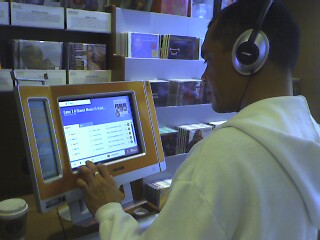
In the course of the visit, I saw the state of the store - bringing back recollections of the first Internet cafes that made their appearance in storefronts back in 1999. As you can see in the following photos, the interface is designed to be simple to use - and potentially give people a chance to enjoy the music and coffee at the same time.

The space included a performance space, which was liberally used for this employee's preview - with a terrific singer named Crystal Bond performing in it when I visited. The coffee is still pure Starbucks, but the music store is focusing on discovery and personal service. Jonathan Lake, project manager for Starbucks, described a focus on helping the customers discover music through referral information (e.g. if you like A, you might enjoy B) to help customers select their music and burn their own CDs (for $0.99 per track - from the examples I saw today).
 As seen here - the "bar" is chocked full of dedicated terminals - and the CD burners lie in the front of the bar. This will be an interesting prototype experiment - I look forward to seeing what happens with the in-store sales.
Tags: HEAR Music Starbucks

In the course of the visit, I saw the state of the store - bringing back recollections of the first Internet cafes that made their appearance in storefronts back in 1999. As you can see in the following photos, the interface is designed to be simple to use - and potentially give people a chance to enjoy the music and coffee at the same time.

The space included a performance space, which was liberally used for this employee's preview - with a terrific singer named Crystal Bond performing in it when I visited. The coffee is still pure Starbucks, but the music store is focusing on discovery and personal service. Jonathan Lake, project manager for Starbucks, described a focus on helping the customers discover music through referral information (e.g. if you like A, you might enjoy B) to help customers select their music and burn their own CDs (for $0.99 per track - from the examples I saw today).
 As seen here - the "bar" is chocked full of dedicated terminals - and the CD burners lie in the front of the bar. This will be an interesting prototype experiment - I look forward to seeing what happens with the in-store sales.
Tags: HEAR Music Starbucks
Monday, February 6
Better targeting through clustering
Ever since my post on google/Yahoo!/Microsoft - I have had a number of conversations about how targeted google is getting. In the past few weeks:
Clustery-goodness
In my first year at Stanford, I discovered that programming - while fun - could be given to better programmers than I. I have always been pretty good at programming, but one discovered that (at Stanford) you can always learn from others. In my AI/Lisp programming course, we were given a task on filling in crossword puzzle matrices using the Unix dictionary. The goal was to create an algorithm to quickly fill in the blanks and submit complete crossword puzzles. Our solution turned out to be a primitve form of "clustering" and a fast search algorithm using a bitwise representation of the dictionary.
Why this walk down memory lane? Consider the problem of tracking the surfing characteristics of the entire World Wide Web. Do you think google really cares about you in particular? As in, what you - Joe Block of 123 Main Street, in Cedar Rapids - really do? Unless you are a googel account holder, not particularly. The goal is to make AdWords and search relevant to you - or at least people like you. So, how does this translate?
Consider the ever popular Myers-Briggs Personality Indicator Test. In it, people answer questions (give information about themselves) and out pops a categorization of yourself - along four dimensions (Extrovert/Introvert, Sensate/Intuitive, Thinking/Feeling, Judgemental/Perceptive). 16 categories, four dimensions - which is 2 to the 4th power (binary!). Now, consider the fact that google has the capacity to handle many more dimensions - on the order of hundreds. What if you were able to determine the major categories (e.g. location, time of day, major topics of the world, frequent requests) and map them into 100,000 categories. Do you think that google might be able to provide relatively targeted information - in aggregate?
Now - include the google account holders. Now - google has a definite tracking of all of the google account holders, with permission to help their searches. Even better - they can now be certain of the clusters necessary for these holders. Now - consider how many people have searching habits like me - across the world. And I now make google's life easier by being a source of demographic, psychographic and click-graphic information to help connect those who are not on the system get better results.
The art of database marketing - with the world's biggest computing system. Any reason why google is worth its market share?
Tags: clustering google gbuy gmail chat
- google launched Personalized Search - now, when I am surfing the web - and my google account is logged in, google is now tracking my search history overtly. No more hiding behind cookies, I am now identified as my google login. Consider the fact that gmail has "millions of users" as quoted in a New York Time article today, and the growth of the authentication platform is across the entire googlescape, that means that google has information on many millions of potential users.
- In that article, google just announced Gmail Chat - a combination of Gmail and IM client software - meaning now, google has information on your IM conversations - an additional source of rich information on your personal habits.
- google's answer to Paypal - GBuy - will now tag products with a google GBuy logo - which you will be able to benefit from.
- Your search history - via the google homepage, the google search bar on your browser or any google-affiliated search box on other websites. And with Personalized Search enabled, your cookies are not the only thing identifying your actions
- Your desktop search and information - what are the key topics you are searching for locally on your hard drive or on any network drive you have connected? google Desktop indexes the information on your desktop - and crushes the index into a fast hash - both for you and themselves
- AdWord-supported websites - which sites have you visited that are currently syndicating AdWords - with each site you go to, google gets a request from your browser to refresh the adverts for the page you pull
- google Analytics websites - now, with Urchin as a free analytic web tracking service offered by google - some of the better websites are incorporating analytics - even without google AdWords. But, with the targeting solution within Analytics, it makes using AdWords that much easier
Clustery-goodness
In my first year at Stanford, I discovered that programming - while fun - could be given to better programmers than I. I have always been pretty good at programming, but one discovered that (at Stanford) you can always learn from others. In my AI/Lisp programming course, we were given a task on filling in crossword puzzle matrices using the Unix dictionary. The goal was to create an algorithm to quickly fill in the blanks and submit complete crossword puzzles. Our solution turned out to be a primitve form of "clustering" and a fast search algorithm using a bitwise representation of the dictionary.
Why this walk down memory lane? Consider the problem of tracking the surfing characteristics of the entire World Wide Web. Do you think google really cares about you in particular? As in, what you - Joe Block of 123 Main Street, in Cedar Rapids - really do? Unless you are a googel account holder, not particularly. The goal is to make AdWords and search relevant to you - or at least people like you. So, how does this translate?
Consider the ever popular Myers-Briggs Personality Indicator Test. In it, people answer questions (give information about themselves) and out pops a categorization of yourself - along four dimensions (Extrovert/Introvert, Sensate/Intuitive, Thinking/Feeling, Judgemental/Perceptive). 16 categories, four dimensions - which is 2 to the 4th power (binary!). Now, consider the fact that google has the capacity to handle many more dimensions - on the order of hundreds. What if you were able to determine the major categories (e.g. location, time of day, major topics of the world, frequent requests) and map them into 100,000 categories. Do you think that google might be able to provide relatively targeted information - in aggregate?
Now - include the google account holders. Now - google has a definite tracking of all of the google account holders, with permission to help their searches. Even better - they can now be certain of the clusters necessary for these holders. Now - consider how many people have searching habits like me - across the world. And I now make google's life easier by being a source of demographic, psychographic and click-graphic information to help connect those who are not on the system get better results.
The art of database marketing - with the world's biggest computing system. Any reason why google is worth its market share?
Tags: clustering google gbuy gmail chat
Thursday, February 2
Is it in the corporate DNA?
Recently, my roommate (who is an analyst for a NY hedge fund) wanted to discuss the differences between the three big Internet players - google, Microsoft and Yahoo! As I began to describe the three companies - I drew out a map of the Internet ecosystem and realized that the inherent cultural DNA governs these three companies and their overall strategies. And, once again, I do not suggest I am uncovering anything new - only presenting what I assume most strategists are thinking - in more laymen's terms.
Manage from the center or the edge
All three players are vying for control of access - from each and eveery way you currently connect to the processes and information that you use to perform your daily tasks or desires. In network terms (Ed. Note - I used to work for Interoute, a pan-European telco), there is the carrier's backbone, the metro networks (fiber in the cities) and the local connections (e.g. fiber to the office or the home). If you take this general structure and consider those three regions as battlegrounds (center, metro and local), the battleground begins to make more sense.
Microsoft - own the edge, build up the center
At it's core, Microsoft has always been an edge device player - the OS exists on devices close to the user - on the order of hundreds of millions - and has had to build a corporation based on the management and optimization of these edge devices. Consider the logistics, the problem solving techniques Microsoft has had to build to handle the challenge of managing the OSes and applications that exist on the platforms. Note how it has been very patient in building it's presence on mobile devices, gaming platforms and cable devices (okay, maybe not so good on WebTV) - but as it continues the inexorable march forward - it has to contend with various challenges (Linux, PalmOS, Lindows, Netscape, Firefox, Sony, Nintendo, etcera) - and then extend itself into other markets (MSNBC, msn.com). But, for all of it's vaunted brainpower - it has an incredible challenge when it faces the two areas that Google and Yahoo exist in: search and media.
Yahoo! - own the center, leverage editorial and the community
Yahoo started as a directory managed by a team of editors - focusing on indexing the Internet the old-fashioned way: using humans to index content in a human-understandable form. In the world of databases, indexing means a hash value that points to some content. Yahoo! built it's value on the human-understandable index of content that a person could look through. The inherent interconnection of content became centralized at Yahoo! - you could find the links between content in the Yahoo! index - all editorialized at the Yahoo! offices. As John Battelle's book points out, Yahoo! now provides additional guidance on the search of information through it's editorial offices - they become the aggregator of taste with the Yahoo! brand. And, if you consider that most people are searching for a strong aggregation brand (think of why we read newspapers or watch a favorite news channel or listen to a particular radio station), Yahoo!'s centralized strategy is just another conception of the media play - become the world's Internet destination and provide the best Yahoo! branded content - which means Yahoo! owns the channel and the influence over the "best" content. And since it owns the content and the community (think of all the boards and eGroups and other community aggregation spaces), it has a pulse on how it's editorial choices are influencing the community - Yahoo! is it's own focus group organization and content "generation" organization.
Does it focus on the edge? Why should it - when the media model is about managing the content and the brand - it is not a tools developer, it uses content and software to create Internet content - not manage how you get to it. Yahoo!'s need for better search is not because it is a search engine, it is because Yahoo! needs to have you (the customer) rely on Yahoo content - and the "good enough" should be there for you to discover their content.
google - own the center with algorithms and sensors
Google's DNA is about search - plain and simple. It has never been about editorial - outside of what the "community" thinks is editorial - using algorithms to determine taste and interest in a "real time" fashion. Think of google as the world's biggest pollster - asking questions and doing deep database analysis on the questions asked. When you get into google's past - it has always been about optimizing clustering - and determine the best "answer" from aggregated data. google's foree into Desktop apps? Is it because it wants to compete with Microsoft? Not exactly.
google needs to be on Desktops simple because it needs more information - and by owning the center - and it has built one of (if not the) best polling systems (read: web crawler), it needs more information. Because now - when news breaks, people publish their opinions, websites change their content - google's crawlers can not be everywhere all the time. But, given the fact that the world is online - each computer becomes google's crawler - and now, when we are told of a new website through our personal network, and we go to it - where is google? On our search bar on the browser, on the desktop search app, on the google Talk, at the website itself in the google analytics - consider how many ways google can now watch your every move. And can they target an individual? As John Battelle points out, absolutely.
This means that google is still centralized - tweaking algorithms, optimizing data storage, running their own data OS across the world (yes, they have been on a buying spree for data centers and bandwidth) - and we are the crawlers. The optimal distributed effort - all of us working for google to optimize the search engine - and reaping the benfits through advertised search.
And the winner is?
Truthfully, I do not see "a winner". Microsoft will always be there on the OS play - even if google developed their own Windows-killer, all of the software that Microsoft has to manage the customer relationships with - google is ill-equipped to create an entire customer service and sales team to handle it. Think of all of google's apps - how many of them offer "customer service"? How many complaints have you heard of in trying to reach a customer service person? And, aside from the sales team, what is the bulk of google's efforts: engineers, project/product managers and sales engineers.
If we are optimizing return on investment - google is a sure fire winner since the service it offers, the reach it has and the efficiencies it has give a better return on capital - when you do not need to handle all of the customer issues (which tends to be the bulk of a corporation's costs), the efficiencies are evident.
Yahoo! - now there is an interesting challenge. Simply - as the other players in the media market gear up - how does it play out? Yahoo maintaining it's Swiss-like state is perfect for aggregating media across the world - providing the Yahoo! channel for all to see. And by managing the brand effectively - they will continue to be the "media channel" of choice for the coming years.
tags: Yahoo microsoft google business models
Manage from the center or the edge
All three players are vying for control of access - from each and eveery way you currently connect to the processes and information that you use to perform your daily tasks or desires. In network terms (Ed. Note - I used to work for Interoute, a pan-European telco), there is the carrier's backbone, the metro networks (fiber in the cities) and the local connections (e.g. fiber to the office or the home). If you take this general structure and consider those three regions as battlegrounds (center, metro and local), the battleground begins to make more sense.
Microsoft - own the edge, build up the center
At it's core, Microsoft has always been an edge device player - the OS exists on devices close to the user - on the order of hundreds of millions - and has had to build a corporation based on the management and optimization of these edge devices. Consider the logistics, the problem solving techniques Microsoft has had to build to handle the challenge of managing the OSes and applications that exist on the platforms. Note how it has been very patient in building it's presence on mobile devices, gaming platforms and cable devices (okay, maybe not so good on WebTV) - but as it continues the inexorable march forward - it has to contend with various challenges (Linux, PalmOS, Lindows, Netscape, Firefox, Sony, Nintendo, etcera) - and then extend itself into other markets (MSNBC, msn.com). But, for all of it's vaunted brainpower - it has an incredible challenge when it faces the two areas that Google and Yahoo exist in: search and media.
Yahoo! - own the center, leverage editorial and the community
Yahoo started as a directory managed by a team of editors - focusing on indexing the Internet the old-fashioned way: using humans to index content in a human-understandable form. In the world of databases, indexing means a hash value that points to some content. Yahoo! built it's value on the human-understandable index of content that a person could look through. The inherent interconnection of content became centralized at Yahoo! - you could find the links between content in the Yahoo! index - all editorialized at the Yahoo! offices. As John Battelle's book points out, Yahoo! now provides additional guidance on the search of information through it's editorial offices - they become the aggregator of taste with the Yahoo! brand. And, if you consider that most people are searching for a strong aggregation brand (think of why we read newspapers or watch a favorite news channel or listen to a particular radio station), Yahoo!'s centralized strategy is just another conception of the media play - become the world's Internet destination and provide the best Yahoo! branded content - which means Yahoo! owns the channel and the influence over the "best" content. And since it owns the content and the community (think of all the boards and eGroups and other community aggregation spaces), it has a pulse on how it's editorial choices are influencing the community - Yahoo! is it's own focus group organization and content "generation" organization.
Does it focus on the edge? Why should it - when the media model is about managing the content and the brand - it is not a tools developer, it uses content and software to create Internet content - not manage how you get to it. Yahoo!'s need for better search is not because it is a search engine, it is because Yahoo! needs to have you (the customer) rely on Yahoo content - and the "good enough" should be there for you to discover their content.
google - own the center with algorithms and sensors
Google's DNA is about search - plain and simple. It has never been about editorial - outside of what the "community" thinks is editorial - using algorithms to determine taste and interest in a "real time" fashion. Think of google as the world's biggest pollster - asking questions and doing deep database analysis on the questions asked. When you get into google's past - it has always been about optimizing clustering - and determine the best "answer" from aggregated data. google's foree into Desktop apps? Is it because it wants to compete with Microsoft? Not exactly.
google needs to be on Desktops simple because it needs more information - and by owning the center - and it has built one of (if not the) best polling systems (read: web crawler), it needs more information. Because now - when news breaks, people publish their opinions, websites change their content - google's crawlers can not be everywhere all the time. But, given the fact that the world is online - each computer becomes google's crawler - and now, when we are told of a new website through our personal network, and we go to it - where is google? On our search bar on the browser, on the desktop search app, on the google Talk, at the website itself in the google analytics - consider how many ways google can now watch your every move. And can they target an individual? As John Battelle points out, absolutely.
This means that google is still centralized - tweaking algorithms, optimizing data storage, running their own data OS across the world (yes, they have been on a buying spree for data centers and bandwidth) - and we are the crawlers. The optimal distributed effort - all of us working for google to optimize the search engine - and reaping the benfits through advertised search.
And the winner is?
Truthfully, I do not see "a winner". Microsoft will always be there on the OS play - even if google developed their own Windows-killer, all of the software that Microsoft has to manage the customer relationships with - google is ill-equipped to create an entire customer service and sales team to handle it. Think of all of google's apps - how many of them offer "customer service"? How many complaints have you heard of in trying to reach a customer service person? And, aside from the sales team, what is the bulk of google's efforts: engineers, project/product managers and sales engineers.
If we are optimizing return on investment - google is a sure fire winner since the service it offers, the reach it has and the efficiencies it has give a better return on capital - when you do not need to handle all of the customer issues (which tends to be the bulk of a corporation's costs), the efficiencies are evident.
Yahoo! - now there is an interesting challenge. Simply - as the other players in the media market gear up - how does it play out? Yahoo maintaining it's Swiss-like state is perfect for aggregating media across the world - providing the Yahoo! channel for all to see. And by managing the brand effectively - they will continue to be the "media channel" of choice for the coming years.
tags: Yahoo microsoft google business models
Subscribe to:
Posts (Atom)